Friday, July 31, 2015

Are Book Rating Systems Futile?

The answer would appear to be yes. If we exclude academics and professional critics, rating books is opinion-based, and opinions, as we all know, are far from universal, standardized, or even at times completely rational. Hell, full reviews are still opinion-based but at least provide more detailed reasons for liking and disliking a book. (For the clarity of this discussion, rating systems are what I’m classifying as simplified headings or markers of what a reviewer thought of a book/story in addition or in place of a more in-depth review such as the five star rating system seen on Goodreads and many other websites that offer product reviews). For many, books are a form of entertainment, but when rating entertainment, can a rating system ever be completely accurate? The answer at first glance would appear to be no. Entertainment is subjective and hard to measure or compare. Several issues arise such as rating personal entertainment vs. quality, ratings from reviewer to reviewer, and the evolution of the reviewer.
Take Goodreads, a site for book reviews, giveaways, reading challenges, etc., which operates on a five star rating system. Many of my books in the same star rating aren’t easily comparable. The Old Man and the Sea, Beautiful Creatures, and To Kill A Mockingbird all have the same three star rating (as far as what I rated them), but they are by far very different books that stars can’t indicate. By rating each of these books as three stars, I am by no means saying that Beautiful Creatures is on par with To Kill A Mockingbird. Huhhhh?

Image result for confusion memes

I know, I know. Yet, on a shallow, cursory level it might appear as exactly that. The issue becomes what does the rating mean or, to phrase it differently, what exactly are the stars rating? Personal enjoyment? Literary value? Quality of writing? Characters? World-building? Many a time I would want to rate a book lower because I didn’t enjoy it, but I would then feel guilty because nothing is per se “wrong” with the book other than it wasn’t the book for me. Therefore, it is highly likely that I can rate Beautiful Creatures three stars for very different reasons than To Kill A Mockingbird. And I can’t be the only one with this problem right? So, if one reviewer’s ratings can vary from book to book, then it’s pretty possible that the nuance of meanings widen when looking from reviewer to reviewer.
Thus, if one person’s ratings from book to book aren’t always comparable, how can ratings be in any way measured from reviewer to reviewer? Do you consider the three star rating as “Good”, “Eh”, or “Has Some Potential”? That alone could alter dramatically how a reviewer rates their books and how you view their ratings.
If a reviewer only lists a book as three stars on Goodreads (versus also having a more in-depth review), is that a book that you would pick up? Or are fours and fives the only books worth your time? Suddenly, the very reviews we go to to determine our purchases seem so arbitrary, if not ridiculous. Yet despite these flaws, book rating systems are everywhere from Amazon to the blog of yours truly, and many of us still use these reviews to shape our opinions.
The issue becomes compounded further if we consider the evolution of the reader/reviewer. There’s no guarantee that I would rate the books I read in high school the same way. In fact, I know from rereading those books and my reviews of them that many of my views have dramatically changed. College classes I’ve taken have changed how I view science fiction and nonfiction, and there are millions of little experiences between my high school years and now that have changed how I view certain types of characters and circumstances. And while I don’t think anyone would doubt that, I believe we all experience even more subtle changes throughout the year: reading ruts, preferences, mood changes, and so on. Perhaps the book we didn’t like a couple months ago was because we weren’t in the mood for that type of book? Or we would have liked that book if we had had a friend recommend that we read past the first 100 pages of backstory? Or perhaps we didn’t quite understand that character or situation at the time? Who knows. Reading is far more complex and subtle than what we sometimes give it credit for which makes the art of reviewing so much harder.
I have found this out first hand with this blog. When I first made my rating system, it seemed clever, funny, and appropriate for me and the platform. However, as I began to use it, I found out more and more that instead of it being my tool I was becoming its slave. I used the American grading system to grade 6 components that I thought were needed in a successful story to average an overall grade. Over time I found that my feelings for how much I enjoyed a book tended to conflict with how I would rate the quality. I might want to rate the components (like world-building, characters, plot, etc.) B’s, but didn’t agree with the overall grade it would lead to (B=Must Read). Thus, the component grades and the overall grades always seemed to struggle for control. To think that I thought that this rating system would be more accurate and understandable than the simplified five star rating system seen on Goodreads!

Image result for confusion memes

Then why is it that so many people on Goodreads alone still rate their books? Does it serve as a public, online reminder of why we liked or disliked a book? Do we have an instinctive need to measure and rate our experiences and compare? Perhaps, both but I think there’s something more to it. Sometimes reviews can be experiences within themselves. Some of my favorite reviewers on Goodreads have amazing wit and snark with a critical eye. I might not always use their reviews as a gauge on what to read but as entertainment in and of itself. Other reviewers I read because they are detailed and balanced with a similar interest to my own. These are the reviews I look to for my to-read list not because they are universally accurate but because they are in line with my own interests. In a way, I end up feeling closer to the reviewer for their personal touch and the overlapping interests we share and thus the reviews begin to feel more like friendly advice than a dictation on good or bad literature.
Ratings might be flawed, but I don’t foresee it going away any time soon. When done well, it can be informative as well as fun. It gives us insight into each other interests, serves as entertainment, and can hopefully help us pick a good book. There are millions upon millions of books and more reviews than we can ever read. Whether its a star rating from Goodreads or my flawed grading system, hopefully ratings will save people from some really bad books and direct them toward the good ones.

So how do you guys feel about ratings and reviews? How do you feel about the five star rating system? Also, if you have time, please look at the rating system below and let me know if you would like it better than the one I currently have. If you guys agree that this one is better, I’ll be doing away with the grades and the components and instead try to go more in-depth in my reviews. My goal with this rating system is to be more in line with how I view the book as far as enjoyment without degrading the ones that just weren’t my cup of tea.

Rating System:
Rereadable
Totally Readable
Readable
Barely Readable

Unreadable

Thursday, July 9, 2015

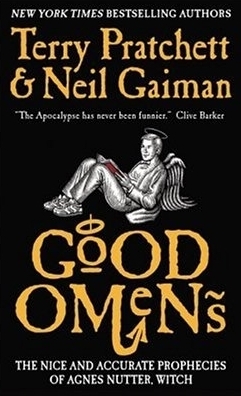
Good Omens by Neil Gaiman and Terry Pratchett Review


Good Omens: The Nice and Accurate Prophecies of Agnes Nutter, Witch

Fiction
413 pages

According to The Nice and Accurate Prophecies of Agnes Nutter, Witch (the world's only completely accurate book of prophecies, written in 1655, before she exploded), the world will end on a Saturday. Next Saturday, in fact. Just before dinner.
So the armies of Good and Evil are amassing, Atlantis is rising, frogs are falling, tempers are flaring. Everything appears to be going according to Divine Plan. Except a somewhat fussy angel and a fast-living demon—both of whom have lived amongst Earth's mortals since The Beginning and have grown rather fond of the lifestyle—are not actually looking forward to the coming Rapture.
And someone seems to have misplaced the Antichrist . . .

Completion: B+
Writing/Style: D-
Characters: C-
Plot/Pacing: D-
World-building/Atmosphere: D-
Sub-genres (Romance, Humor, Mystery, etc.): F


Final Grade: D- At Your Own Risk


This book bummed me out so much. I wanted to like it so much, but instead it was a chore to read. Between the ridiculous quirkiness and constantly changing point of view, there was no tension in the plot or emotional investment in the characters. Even though things do happen in the book, the pace just feels like it always meanders on detours to try to be funny or quirky. Some of the characters had potential, but they never become anything more than quirky, shallow stereotypes. Since there was such a drive for everyone and everything to be quirky, no one seemed to react naturally or believably which really reduced the possible tension to next to nothing. It just felt as if this book was built on some great philosophical ideas that never grew into an organic story and was trying to mask it with humor that’s just not my cup of tea. In fact, this book was written as if it was the funniest thing in the world, and every line was a big joke. Instead, I just felt left out of the joke. I laughed only once and it took to page 83 (the hellhound naming scene, for those who have read the book) for even that. I had always heard that Neil Gaiman and Terry Pratchett were gods of writing, but I was very disappointed in this book. Sad to say, but I wouldn't have even finished it if I didn’t have this book blog to think about. However, I think what disappoints me the most is the glimmers of a good book (or at least some good lines and ideas) that popped up every now and again. One line toward the end brings up the idea that the conflict of the world is less like chess and more like God playing Solitaire which I thought was brilliant. And the ending held some strong lines and imagery that created a surge of nostalgia which was equally surprising as it was refreshing since most of the book left me dead and dull. This is the second book of Gaiman's I've read so I'm starting to come to the conclusion his books just might not be for me. Le sigh...on to the next book.

Tuesday, July 7, 2015

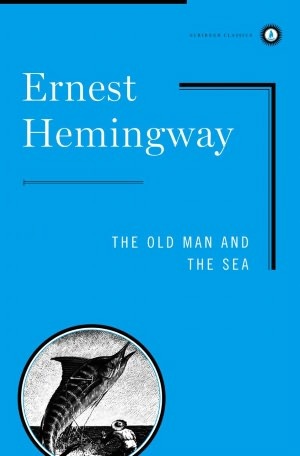
The Old Man and The Sea by Ernest Hemingway Review


The Old Man and the Sea

Fiction
132 pages

Here, for a change, is a fish tale that actually does honor to the author. The Old Man & the Sea revived Hemingway's career, which was foundering under the weight of such postwar stinkers as Across the River & into the Trees. It also led directly to his receipt of the 1954 Nobel Prize--an award he gladly accepted, despite his earlier observation that "no son of a bitch that ever won the Nobel Prize ever wrote anything worth reading afterwards". A half century later, it's still easy to see why. This tale of an aged Cuban fisherman going head-to-head with a magnificent marlin encapsulates Hemingway's favorite motifs of physical & moral challenge. The Old Man & the Sea was, in any case, the last great catch of Hemingway's career.

Completion: A+
Writing/Style: B
Characters: B+
Plot/Pacing: B-
World-building/Atmosphere: B
Sub-genres (Romance, Humor, Mystery, etc.): N/A


Final Grade: B+ Must Read


This novel was a happy surprise since most of my friends have told me how much they hate Hemingway, and I have had very little exposure to his work. However, even though I ended up enjoying it much more than I expected, I still find that it, along with some other books I have read recently, this book has made me acknowledge the flaws in my rating system and perhaps the flaw of any rating system.
 For a story that comprises mostly of one character alone for a long stretch of time doing only one thing, The Old Man and The Sea was a compelling read. It takes a great talent to make one character by himself interesting and dynamic and to have to a writing style that constantly drives his journey forward without losing steam. Of course, there is no need for me to overly praise Hemingway’s skill for there would be a line of people behind me ready to prove me wrong if I had said otherwise.
However, I wouldn’t say that the final grade isn’t completely accurate. I thought the story was good (don’t get me wrong!), but is it really worthy of a Must Read? I found this book a mild enjoyment that convinced me to follow through to the end, but ended with a reasonable but not particularly satisfying ending. I think if you are interested or curious in classics it wouldn’t be a bad one to check out, but I can’t honestly say that you must read it.
Yet, I found myself in the dilemma that I couldn’t bring the final grade down without making it appear that one of the six subcategories was lesser than what I thought it was. How am I to balance these two issues? I’m not quite sure yet. Perhaps, I will redo my rating system. Perhaps, not. In the near future, I might write a Topics post on the accuracy of rating systems. But for now, just know that The Old Man and The Sea didn’t blow me out of the water but did succeed in pushing me to its ending and to trying out more Hemingway books.

Friday, June 19, 2015

Book Tag!

            I’ve wanted to do a book tag for a while now so I found this fast and fun little one. Are we similar or would you answer these questions differently? Let me know in the comments below!

Question 1: Do you have a certain place at home for reading?
Not really. Currently, I tend to read on the couch in my living room since my room is pretty toasty here in the summer. However, I don’t have any particular spot that I can consider “my reading spot”.

Question 2: Bookmark or random piece of paper?
Neither. Normally, I just remember the page or if I’m reading multiple books at one time like I’m doing now, I keep track of them on Goodreads.

Question 3: Can you stop reading anytime you want or do you have to stop at a certain page, chapter, part, etc.?
If I’m being interrupted by something, I try to at least get to the end of a paragraph so it’s easier to remember where I’m at. Otherwise, it’s whenever I feel like I’m at a good stopping point which could be at the end of a chapter or whenever the plot slows down.

Question 4: Do you eat or drink while reading?
I prefer not to eat because I would hate for anything to get on my books. I think tea can go quite nice with a book, especially on a rainy day, but it’s not a habit of mine or anything.

Question 5: Can you read while listening to music/watching TV?
I can and I have read while one of these were happening, but I can’t say I’ve ever played music while I’ve been reading. Sometimes I will watch TV and then read during the commercial breaks or use the TV for background noise. However, if someone else is playing music or watching TV, I’m pretty good at tuning that out.

Question 6: One book at a time or several at once?
Normally, I do one book at a time when I’m completely engrossed in the story. I mostly do several books at once when I’m not completely obsessed with any of them but still feel compelled to read them for school or whatever.

Question 7: Reading at home or everywhere?
I can and do read everywhere! I was definitely that kid that walked around the hallways at school with a book in hand. Did the teacher take a breath between words? I’m reading. Are we reviewing something? I’m reading. Now, this did get a little harder for me in college. Since we aren’t forced to stay at school for hours with busy work, I can go back to my room and…Youtube. Hours and hours of Youtube. I’m kind of addicted, but I’m trying to get back to my bookish ways. I definitely want to reach my book goal this year!

Question 8: Reading out loud or silently in your head?
Silently. The only time I would read out loud is if I found the language confusing such as if a book was from an older time or trying to imitate vernacular/accents.

Question 9: Do you read ahead or skip pages?
Not really. If I like a book, I don’t want to spoil myself. If I’m close to setting the book down permanently, then I might read ahead or skim pages in order to see if the story gets better or just to find out how it ends.

Question 10: Breaking the spine or keeping it new?
I like to try to keep my books looking new and pristine. However, I’m cursed with always ruining my books with a folded page or a coffee stain or what-have-you. Alas, breaking a spine kills me no matter how many times I accidentally do it.

Question 11: Do you write in books?

When I was in middle school, my teacher recommended that I write and underline in my books, and I’ve always regretted it. I cringe at the few books I did that to. She said to underline words I liked or didn’t know and to write down any notes or revelations I had. What I was left with was books I couldn’t sell because I had marked them up and which remind me of just how many words I liked or wanted use more back then. Now that there’s e-books I would be less opposed to doing something similar, but with physical copies I just don’t think it’s worthwhile.

Monday, June 15, 2015

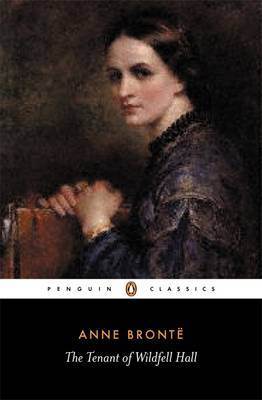
The Tenant of Wildfell Hall by Anne Bronte Review


The Tenant of Wildfell Hall

Fiction
535 pages

Gilbert Markham is deeply intrigued by Helen Graham, a beautiful and secretive young widow who has moved into nearby Wildfell Hall with her young son. He is quick to offer Helen his friendship, but when her reclusive behavior becomes the subject of local gossip and speculation, Gilbert begins to wonder whether his trust in her has been misplaced. It is only when she allows Gilbert to read her diary that the truth is revealed and the shocking details of her past.
Told with great immediacy, combined with wit and irony, The Tenant of Wildfell Hall is a powerfully involving read.

Completion: A
Writing/Style: D
Characters: F
Plot/Pacing: D-
World-building/Atmosphere: D-
Sub-genres (Romance, Humor, Mystery, etc.): F

Final Grade: D- At Your Own Risk

            This book nearly killed me. If you were wondering why it has taken me so long to update with another review, it is because it took me over a month to finish this one. It took an almost insurmountable effort to pick it back up after setting it down. The pacing was poor, the characters were horrible, the romance disgusting and unbelievable, and the narrator absolutely appalling. I’m going to go into some spoilery details, but since I don’t think you should read this book I really don’t care and neither should you. There are three main guys in this story, and they are horrible people (and not in the good, interesting way). Let’s get a list going of these lovelies, shall we?

            Gilbert Markham: main narrator
                        -suffers from Nice Guy Syndrome (aka won’t take no for an answer, always views himself as a victim, hurts everyone around him and then blames others, etc.)
                        -stalks Helen Graham
                        -befriends Helen’s son under false pretenses
                        -beats the crap out of his “friend” who he thinks is getting too close to Helen and then gets upset when said friend doesn’t want his help after the beating
                        -self-justification and major narcissism
                        -befriends Helen’s brother (the friend he beat up before) in order to stay close to Helen/get news about Helen
                        -drama queen

            Arthur Huntingdon: Helen’s husband
                        -a drunk
                        -a liar
                        -an adulterer
                        -makes his friend relapse into gambling and alcoholism because his friend was “boring” sober apparently
                        -doesn’t care for his son and views him as a competitor for his wife’s attention
                        -tries to turn his son against Helen

            Mr. Hargrave: friend to Arthur
                        -suffers from Nice Guy Syndrome as well


            And if these people weren’t frustrating enough, there’s Helen. While she’s not a “bad” person, her holier-than-thou attitude gets old real quick and creates a really monotonous and infuriating back and forth between her and the other characters. It’s as if Anne Bronte was trying to write a romance without any of the fun or romance. Now of course, Helen miraculously falls for Markham in the end which is only more disgusting by the fact that he hasn’t changed in the slightest, and they have zero believable chemistry between them. Even though Markham says he is nothing like Hargrave, I really couldn’t tell which of them was worse because they were so similar (except for some reason Helen likes Markham). Helen is essentially a mix between a punching bag and a chew toy for the other characters which is nauseating to read especially for how long this book goes on. The pacing was slow and sporadic, making this tragedy of a book go on much longer than it should have. There is nothing appealing about this book, and everything about it made me want to put it down and never pick it back up. I wouldn’t wish this book on my worst enemy. 

Friday, June 5, 2015

Beautiful Creatures by Kami Garcia Review


Beautiful Creatures (Caster Chronicles, #1) 

Fiction
563 pages

In Ethan Wate's hometown there lies the darkest of secrets . . There is a girl. Slowly, she pulled the hood from her head . . . Green eyes, black hair. Lena Duchannes. There is a curse. On the Sixteenth Moon, the Sixteenth Year, the Book will take what it's been promised. And no one can stop it. In the end, there is a grave. Lena and Ethan become bound together by a deep, powerful love. But Lena is cursed and on her sixteenth birthday, her fate will be decided. Ethan never even saw it coming.

Completion: A
Writing/Style: B-
Characters: B
Plot/Pacing: C-
World-building/Atmosphere: C-
Sub-genres (Romance, Humor, Mystery, etc.): C-

Final Grade: C+ Library Rental

     Between the Instalove, cursed love, and GOOD vs. EVIL, I went into this book pretty sure it wouldn't be one of my favorites. And, of course, I was right. However, it was popular enough to become a movie so I was intrigued enough to find out.
First, setting the story in the South was a nice, interesting choice which could have been so much more interesting if it wasn’t so stereotyped with such narrow-minded people (apparently cheerleaders are petty “sluts” everywhere in this fine country).
Second, while the dramatic and sudden nature of the main characters' relationships is cliched and annoying, they definitely feel more realistic and better matched than Edward and Bella from Twilight. I know that’s not much, but it’s something, I guess. While their relationship wasn’t believable for a lot of it, it never crossed into abusive.
Third, the side characters, for the most part, were colorful and entertaining. Amma, Macon, and Ethan’s aunts were good additions to the story instead of the complete cardboard cutouts they very easily could of been. Also, I appreciated the fact that Ethan never quite gets over his mother, who is dead, and his father, who is too distraught by his wife’s death to function. Ethan’s lonely ache for his parents and the past cling to him throughout the novel, making him sympathetic and more realistic.
Often times, the deaths of parents are just a lazy author’s excuse for a main character’s lack of parental supervision so I was glad that it added up to be more than that. Ethan’s love for books also makes sense beyond trying to make him relatable because it connects him with his dead mother who loved books.
     Now, to elaborate on what I didn’t like. As mentioned before, Ethan and Lena’s relationship is chock full of Instalove with a side order of doomed love. Massive eye roll. There’s even the obvious Leave-me-I’m-not-good-for-you conversation that always seems to happen in these kinds of stories (Mild Spoiler: this conversation made even less sense in this story because Ethan and Lena can communicate telepathically from the get go, and Ethan barely flinches at that revelation so Lena’s pushing Ethan away seems a little pointless.)
Of course, there’s all the petty high school drama with the cheerleaders and not fitting in and wanting to go to the school dance. Basically, all the fundamental pitfalls of cliched YA. I guess the thing that always kept me one step back from falling into the plot was the whole GOOD vs. EVIL thing which bugged me the most.
The reason why this never works for me as a storyline is that you can’t quantify evil-ness or good-ness. I don’t believe someone could be all evil and can only do evil actions. Humans are more complex than that. Macon and Ridley are more complex than that.
Lena and her family are witches essentially even though in this story they are referred to as casters. Most casters get to pick when they are 16 if they want to be good or evil, but Lena’s family is cursed with not being able to choose. But here’s the thing: why would anyone choose evil? What’s the benefit of going dark? This is NEVER explained.
Now, for those of you who have read the book, yes, yes, I know it is explained why Lena would go dark, but never why any ordinary caster would choose to go dark. Also, the evil people aren’t that evil to be honest. So…they wreck prom? They give people surprise parties? They like lollipops and wear revealing clothing? Oh boy, am I terrified. Also, I would imagine that the isolation and neglect these people experience from their family when they are cast out for “going dark” explains their behavior more than any magical reason.
     It’s a pity because this book could have been so much more if it hadn’t rested on tropes and cliches. I saw glimpses of potential that were overwhelmed by slogs of purple prose and forced drama. In the end, this book is pretty harmless. While it could be a bit frustrating or boring at times, it was never painstakingly horrible. Back in my middle school days, I might have even liked it. Who knows. As it is, I would say give it a pass unless you have some free time at a library.

Tuesday, June 2, 2015

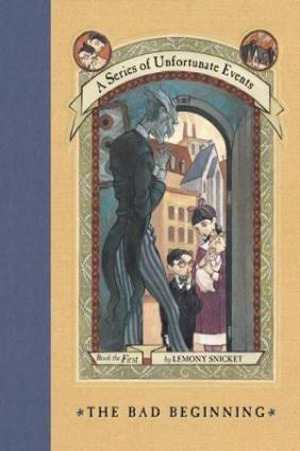
A Series of Unfortunate Events: A Bad Beginning by Lemony Snicket Review


The Bad Beginning (A Series of Unfortunate Events, #1)

Fiction
176 pages

Dear Reader,
     I'm sorry to say that the book you are holding in your hands is extremely unpleasant. It tells an unhappy tale about three very unlucky children. Even though they are charming and clever, the Baudelaire siblings lead lives filled with misery and woe. From the very first page of this book when the children are at the beach and receive terrible news, continuing on through the entire story, disaster lurks at their heels. One might say they are magnets for misfortune.
     In this short book alone, the three youngsters encounter a greedy and repulsive villain, itchy clothing, a disastrous fire, a plot to steal their fortune, and cold porridge for breakfast.
     It is my sad duty to write down these unpleasant tales, but there is nothing stopping you from putting this book down at once and reading something happy, if you prefer that sort of thing.
With all due respect,
Lemony Snicket

Completion: A
Writing/Style: D
Characters: C-
Plot/Pacing: B-
World-building/Atmosphere: C-
Sub-genres (Romance, Humor, Mystery, etc.): D-

Final Grade: C Library Rental

Disclaimer: For all those out there that have fond feelings toward this book, you all might want to turn away from this review now. I did not really care for it. At all. Proceed with caution.

Alas, I wish I could have liked this book more. I have only heard good things about this book and I hate to say that I couldn’t have been one of those people who loved it. I know many people love this series and are nostalgic to it, but I'm afraid I just could not see the appeal. The story was adequate and not too shabby. If you are able to suspend your disbelief, the mystery of Olaf’s scheme is actually pretty clever. However, the characters, especially the main three, relied more on stereotypes and quirks than anything else, which made it hard for me to become emotionally invested in them. As well bad things happen from start to end (as the title suggests), and yet they are made out to be mundane and even forewarned so I hardly blinked an eye when they happened. Evil people are evil for no reason, and we are to root for the main characters because, well, they are the main characters. Furthermore and most importantly, the narrator frequently uses higher leveled words and then explains what the words mean, which only serves as interrupting vocabulary lessons that stunt the story. For example:

“They purchased garlic, which is a sharp-tasting bulbous plant”.

So kids won’t know what garlic is, but they’ll know the word “bulbous”? How does that make any sense? Plus, part of the point of reading is the subtle learning through context clues and other techniques and not shoving it down their throats. As a whole, I felt these additions were condescending. In other cases, it seems like these vocabulary lessons were meant to be humorous, but in my case, they really did not come off well. For example:

“He saw Klaus sitting at the table and smirked, a word which here means ‘smiled in an unfriendly, phony way”.

Oh, boy, isn’t that just hilarious? No? Well, have fun with that being the only source of humor throughout the whole book. Also, now this is just nitpicking at this point, but I have to point it out because it bothers me so much:

“Violet Baudelaire, the eldest, liked to skip rocks. Like most fourteen-year-olds, she was right-handed…”

Uh, say what? Most fourteen year olds are right-handed, you say? What does hand preference have to do with age? Why do these details even matter? Ugh. As you can probably tell by now, the writing style nearly killed me. If this had been a longer book, I would not have finished it for this reason. It’s sad to think that the writing style could overshadow the good aspects of a book, but it did.
Having seen the movie, I must say that I believe this story would have benefited from being in a different medium like a graphic novel or cartoon, which would have allowed it more leeway in suspending disbelief. In its current state, I found it more than a bit lacking.