Friday, June 19, 2015

Book Tag!

            I’ve wanted to do a book tag for a while now so I found this fast and fun little one. Are we similar or would you answer these questions differently? Let me know in the comments below!

Question 1: Do you have a certain place at home for reading?
Not really. Currently, I tend to read on the couch in my living room since my room is pretty toasty here in the summer. However, I don’t have any particular spot that I can consider “my reading spot”.

Question 2: Bookmark or random piece of paper?
Neither. Normally, I just remember the page or if I’m reading multiple books at one time like I’m doing now, I keep track of them on Goodreads.

Question 3: Can you stop reading anytime you want or do you have to stop at a certain page, chapter, part, etc.?
If I’m being interrupted by something, I try to at least get to the end of a paragraph so it’s easier to remember where I’m at. Otherwise, it’s whenever I feel like I’m at a good stopping point which could be at the end of a chapter or whenever the plot slows down.

Question 4: Do you eat or drink while reading?
I prefer not to eat because I would hate for anything to get on my books. I think tea can go quite nice with a book, especially on a rainy day, but it’s not a habit of mine or anything.

Question 5: Can you read while listening to music/watching TV?
I can and I have read while one of these were happening, but I can’t say I’ve ever played music while I’ve been reading. Sometimes I will watch TV and then read during the commercial breaks or use the TV for background noise. However, if someone else is playing music or watching TV, I’m pretty good at tuning that out.

Question 6: One book at a time or several at once?
Normally, I do one book at a time when I’m completely engrossed in the story. I mostly do several books at once when I’m not completely obsessed with any of them but still feel compelled to read them for school or whatever.

Question 7: Reading at home or everywhere?
I can and do read everywhere! I was definitely that kid that walked around the hallways at school with a book in hand. Did the teacher take a breath between words? I’m reading. Are we reviewing something? I’m reading. Now, this did get a little harder for me in college. Since we aren’t forced to stay at school for hours with busy work, I can go back to my room and…Youtube. Hours and hours of Youtube. I’m kind of addicted, but I’m trying to get back to my bookish ways. I definitely want to reach my book goal this year!

Question 8: Reading out loud or silently in your head?
Silently. The only time I would read out loud is if I found the language confusing such as if a book was from an older time or trying to imitate vernacular/accents.

Question 9: Do you read ahead or skip pages?
Not really. If I like a book, I don’t want to spoil myself. If I’m close to setting the book down permanently, then I might read ahead or skim pages in order to see if the story gets better or just to find out how it ends.

Question 10: Breaking the spine or keeping it new?
I like to try to keep my books looking new and pristine. However, I’m cursed with always ruining my books with a folded page or a coffee stain or what-have-you. Alas, breaking a spine kills me no matter how many times I accidentally do it.

Question 11: Do you write in books?

When I was in middle school, my teacher recommended that I write and underline in my books, and I’ve always regretted it. I cringe at the few books I did that to. She said to underline words I liked or didn’t know and to write down any notes or revelations I had. What I was left with was books I couldn’t sell because I had marked them up and which remind me of just how many words I liked or wanted use more back then. Now that there’s e-books I would be less opposed to doing something similar, but with physical copies I just don’t think it’s worthwhile.

Monday, June 15, 2015

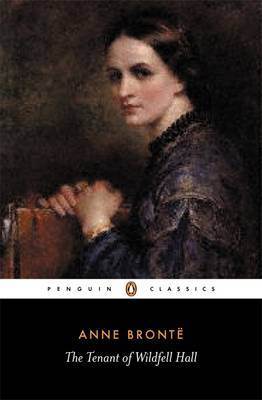
The Tenant of Wildfell Hall by Anne Bronte Review


The Tenant of Wildfell Hall

Fiction
535 pages

Gilbert Markham is deeply intrigued by Helen Graham, a beautiful and secretive young widow who has moved into nearby Wildfell Hall with her young son. He is quick to offer Helen his friendship, but when her reclusive behavior becomes the subject of local gossip and speculation, Gilbert begins to wonder whether his trust in her has been misplaced. It is only when she allows Gilbert to read her diary that the truth is revealed and the shocking details of her past.
Told with great immediacy, combined with wit and irony, The Tenant of Wildfell Hall is a powerfully involving read.

Completion: A
Writing/Style: D
Characters: F
Plot/Pacing: D-
World-building/Atmosphere: D-
Sub-genres (Romance, Humor, Mystery, etc.): F

Final Grade: D- At Your Own Risk

            This book nearly killed me. If you were wondering why it has taken me so long to update with another review, it is because it took me over a month to finish this one. It took an almost insurmountable effort to pick it back up after setting it down. The pacing was poor, the characters were horrible, the romance disgusting and unbelievable, and the narrator absolutely appalling. I’m going to go into some spoilery details, but since I don’t think you should read this book I really don’t care and neither should you. There are three main guys in this story, and they are horrible people (and not in the good, interesting way). Let’s get a list going of these lovelies, shall we?

            Gilbert Markham: main narrator
                        -suffers from Nice Guy Syndrome (aka won’t take no for an answer, always views himself as a victim, hurts everyone around him and then blames others, etc.)
                        -stalks Helen Graham
                        -befriends Helen’s son under false pretenses
                        -beats the crap out of his “friend” who he thinks is getting too close to Helen and then gets upset when said friend doesn’t want his help after the beating
                        -self-justification and major narcissism
                        -befriends Helen’s brother (the friend he beat up before) in order to stay close to Helen/get news about Helen
                        -drama queen

            Arthur Huntingdon: Helen’s husband
                        -a drunk
                        -a liar
                        -an adulterer
                        -makes his friend relapse into gambling and alcoholism because his friend was “boring” sober apparently
                        -doesn’t care for his son and views him as a competitor for his wife’s attention
                        -tries to turn his son against Helen

            Mr. Hargrave: friend to Arthur
                        -suffers from Nice Guy Syndrome as well


            And if these people weren’t frustrating enough, there’s Helen. While she’s not a “bad” person, her holier-than-thou attitude gets old real quick and creates a really monotonous and infuriating back and forth between her and the other characters. It’s as if Anne Bronte was trying to write a romance without any of the fun or romance. Now of course, Helen miraculously falls for Markham in the end which is only more disgusting by the fact that he hasn’t changed in the slightest, and they have zero believable chemistry between them. Even though Markham says he is nothing like Hargrave, I really couldn’t tell which of them was worse because they were so similar (except for some reason Helen likes Markham). Helen is essentially a mix between a punching bag and a chew toy for the other characters which is nauseating to read especially for how long this book goes on. The pacing was slow and sporadic, making this tragedy of a book go on much longer than it should have. There is nothing appealing about this book, and everything about it made me want to put it down and never pick it back up. I wouldn’t wish this book on my worst enemy. 

Friday, June 5, 2015

Beautiful Creatures by Kami Garcia Review


Beautiful Creatures (Caster Chronicles, #1) 

Fiction
563 pages

In Ethan Wate's hometown there lies the darkest of secrets . . There is a girl. Slowly, she pulled the hood from her head . . . Green eyes, black hair. Lena Duchannes. There is a curse. On the Sixteenth Moon, the Sixteenth Year, the Book will take what it's been promised. And no one can stop it. In the end, there is a grave. Lena and Ethan become bound together by a deep, powerful love. But Lena is cursed and on her sixteenth birthday, her fate will be decided. Ethan never even saw it coming.

Completion: A
Writing/Style: B-
Characters: B
Plot/Pacing: C-
World-building/Atmosphere: C-
Sub-genres (Romance, Humor, Mystery, etc.): C-

Final Grade: C+ Library Rental

     Between the Instalove, cursed love, and GOOD vs. EVIL, I went into this book pretty sure it wouldn't be one of my favorites. And, of course, I was right. However, it was popular enough to become a movie so I was intrigued enough to find out.
First, setting the story in the South was a nice, interesting choice which could have been so much more interesting if it wasn’t so stereotyped with such narrow-minded people (apparently cheerleaders are petty “sluts” everywhere in this fine country).
Second, while the dramatic and sudden nature of the main characters' relationships is cliched and annoying, they definitely feel more realistic and better matched than Edward and Bella from Twilight. I know that’s not much, but it’s something, I guess. While their relationship wasn’t believable for a lot of it, it never crossed into abusive.
Third, the side characters, for the most part, were colorful and entertaining. Amma, Macon, and Ethan’s aunts were good additions to the story instead of the complete cardboard cutouts they very easily could of been. Also, I appreciated the fact that Ethan never quite gets over his mother, who is dead, and his father, who is too distraught by his wife’s death to function. Ethan’s lonely ache for his parents and the past cling to him throughout the novel, making him sympathetic and more realistic.
Often times, the deaths of parents are just a lazy author’s excuse for a main character’s lack of parental supervision so I was glad that it added up to be more than that. Ethan’s love for books also makes sense beyond trying to make him relatable because it connects him with his dead mother who loved books.
     Now, to elaborate on what I didn’t like. As mentioned before, Ethan and Lena’s relationship is chock full of Instalove with a side order of doomed love. Massive eye roll. There’s even the obvious Leave-me-I’m-not-good-for-you conversation that always seems to happen in these kinds of stories (Mild Spoiler: this conversation made even less sense in this story because Ethan and Lena can communicate telepathically from the get go, and Ethan barely flinches at that revelation so Lena’s pushing Ethan away seems a little pointless.)
Of course, there’s all the petty high school drama with the cheerleaders and not fitting in and wanting to go to the school dance. Basically, all the fundamental pitfalls of cliched YA. I guess the thing that always kept me one step back from falling into the plot was the whole GOOD vs. EVIL thing which bugged me the most.
The reason why this never works for me as a storyline is that you can’t quantify evil-ness or good-ness. I don’t believe someone could be all evil and can only do evil actions. Humans are more complex than that. Macon and Ridley are more complex than that.
Lena and her family are witches essentially even though in this story they are referred to as casters. Most casters get to pick when they are 16 if they want to be good or evil, but Lena’s family is cursed with not being able to choose. But here’s the thing: why would anyone choose evil? What’s the benefit of going dark? This is NEVER explained.
Now, for those of you who have read the book, yes, yes, I know it is explained why Lena would go dark, but never why any ordinary caster would choose to go dark. Also, the evil people aren’t that evil to be honest. So…they wreck prom? They give people surprise parties? They like lollipops and wear revealing clothing? Oh boy, am I terrified. Also, I would imagine that the isolation and neglect these people experience from their family when they are cast out for “going dark” explains their behavior more than any magical reason.
     It’s a pity because this book could have been so much more if it hadn’t rested on tropes and cliches. I saw glimpses of potential that were overwhelmed by slogs of purple prose and forced drama. In the end, this book is pretty harmless. While it could be a bit frustrating or boring at times, it was never painstakingly horrible. Back in my middle school days, I might have even liked it. Who knows. As it is, I would say give it a pass unless you have some free time at a library.

Tuesday, June 2, 2015

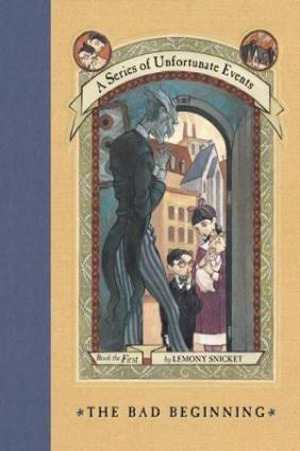
A Series of Unfortunate Events: A Bad Beginning by Lemony Snicket Review


The Bad Beginning (A Series of Unfortunate Events, #1)

Fiction
176 pages

Dear Reader,
     I'm sorry to say that the book you are holding in your hands is extremely unpleasant. It tells an unhappy tale about three very unlucky children. Even though they are charming and clever, the Baudelaire siblings lead lives filled with misery and woe. From the very first page of this book when the children are at the beach and receive terrible news, continuing on through the entire story, disaster lurks at their heels. One might say they are magnets for misfortune.
     In this short book alone, the three youngsters encounter a greedy and repulsive villain, itchy clothing, a disastrous fire, a plot to steal their fortune, and cold porridge for breakfast.
     It is my sad duty to write down these unpleasant tales, but there is nothing stopping you from putting this book down at once and reading something happy, if you prefer that sort of thing.
With all due respect,
Lemony Snicket

Completion: A
Writing/Style: D
Characters: C-
Plot/Pacing: B-
World-building/Atmosphere: C-
Sub-genres (Romance, Humor, Mystery, etc.): D-

Final Grade: C Library Rental

Disclaimer: For all those out there that have fond feelings toward this book, you all might want to turn away from this review now. I did not really care for it. At all. Proceed with caution.

Alas, I wish I could have liked this book more. I have only heard good things about this book and I hate to say that I couldn’t have been one of those people who loved it. I know many people love this series and are nostalgic to it, but I'm afraid I just could not see the appeal. The story was adequate and not too shabby. If you are able to suspend your disbelief, the mystery of Olaf’s scheme is actually pretty clever. However, the characters, especially the main three, relied more on stereotypes and quirks than anything else, which made it hard for me to become emotionally invested in them. As well bad things happen from start to end (as the title suggests), and yet they are made out to be mundane and even forewarned so I hardly blinked an eye when they happened. Evil people are evil for no reason, and we are to root for the main characters because, well, they are the main characters. Furthermore and most importantly, the narrator frequently uses higher leveled words and then explains what the words mean, which only serves as interrupting vocabulary lessons that stunt the story. For example:

“They purchased garlic, which is a sharp-tasting bulbous plant”.

So kids won’t know what garlic is, but they’ll know the word “bulbous”? How does that make any sense? Plus, part of the point of reading is the subtle learning through context clues and other techniques and not shoving it down their throats. As a whole, I felt these additions were condescending. In other cases, it seems like these vocabulary lessons were meant to be humorous, but in my case, they really did not come off well. For example:

“He saw Klaus sitting at the table and smirked, a word which here means ‘smiled in an unfriendly, phony way”.

Oh, boy, isn’t that just hilarious? No? Well, have fun with that being the only source of humor throughout the whole book. Also, now this is just nitpicking at this point, but I have to point it out because it bothers me so much:

“Violet Baudelaire, the eldest, liked to skip rocks. Like most fourteen-year-olds, she was right-handed…”

Uh, say what? Most fourteen year olds are right-handed, you say? What does hand preference have to do with age? Why do these details even matter? Ugh. As you can probably tell by now, the writing style nearly killed me. If this had been a longer book, I would not have finished it for this reason. It’s sad to think that the writing style could overshadow the good aspects of a book, but it did.
Having seen the movie, I must say that I believe this story would have benefited from being in a different medium like a graphic novel or cartoon, which would have allowed it more leeway in suspending disbelief. In its current state, I found it more than a bit lacking.

Wednesday, May 13, 2015

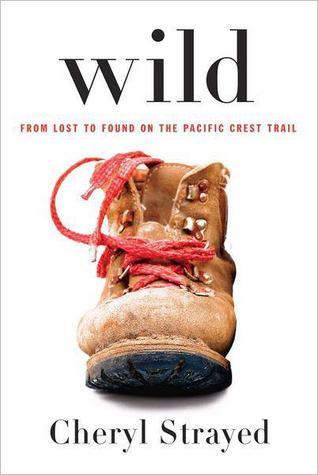
Wild: From Lost to Found on the Pacific Crest Trail by Cheryl Strayed Review


Wild: From Lost to Found on the Pacific Crest Trail

Memoir
336 pages

     At twenty-two, Cheryl Strayed thought she had lost everything. In the wake of her mother’s death, her family scattered and her own marriage was soon destroyed. Four years later, with nothing more to lose, she made the most impulsive decision of her life. With no experience or training, driven only by blind will, she would hike more than a thousand miles of the Pacific Crest Trail from the Mojave Desert through California and Oregon to Washington State — and she would do it alone.
Told with suspense and style, sparkling with warmth and humor, Wild powerfully captures the terrors and pleasures of one young woman forging ahead against all odds on a journey that maddened, strengthened, and ultimately healed her.

Completion: A+
Writing/Style: A
Characters: A+
Plot/Pacing: A-
World-building/Atmosphere: A+
Sub-genres (Romance, Humor, Mystery, etc.): A+

Final Grade: A+ Get Thee to a Bookstore!

As I read this night after night during my last couple weeks of my college semester, I felt like I really went hiking on the Pacific Crest Trail with Cheryl Strayed. Strayed is a devastatingly good writer, making me cry only thirty pages into the memoir. 
From the odd encounters with people and wildlife to the stunning views, the writing transported me into this place and moment in time. The pacing with content like this must have been tricky, and this book could have easily become episodic and distant or tedious in its sporadic events. However, the reading of this novel was more like a smooth car ride: I was able to feel the distant gained, going up and down the heights and valleys with none of the motion sickness. Strayed effortlessly describes the grind of the trail, the surprise of these wild characters and events, and the emotional and spiritual residence such an experience carries.
I will keep this review brief for I would hate to spoil the experience nor do I want my relentless praise to turn any of you away from it. So, I suppose I will end the review on this: read it. Who do I recommend this memoir to? People.

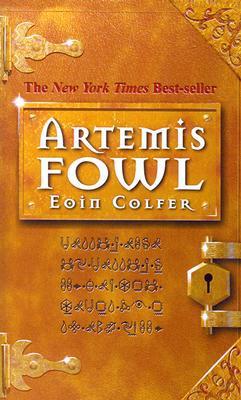
Artemis Fowl by Eoin Colfer Review


Artemis Fowl (Artemis Fowl, #1)

Fiction
316 pages

Twelve-year-old Artemis Fowl is a millionaire, a genius—and, above all, a criminal mastermind. But even Artemis doesn't know what he's taken on when he kidnaps a fairy, Captain Holly Short of the LEPrecon Unit. These aren't the fairies of bedtime stories—they're dangerous! Full of unexpected twists and turns, Artemis Fowl is a riveting, magical adventure.


Completion: A
Writing/Style: C+
Characters: C-
Plot/Pacing: C-
World-building/Atmosphere: C+
Sub-genres (Romance, Humor, Mystery, etc.): C-

Final Grade: C+ Library Rental

  This novel was a really mixed bag. The whole second half of this book I spent wondering what exactly this book was: middle grade? Young adult? Now, this normally doesn’t bother me. In fact, I cannot think of a single instance where I’ve even really given it much thought.
However, the writing in this story is such an odd mix of overly high level material mixed in with pandering, obvious immaturity that I still don’t know what to think. On one page the narrator would be talking about taxes, the economy, killing whales for oil, and other content that I just wouldn’t expect from a young adult book much less a middle grade book, but then on the next page the narrator would make farts and other bodily functions important to the lore and the plot. The book really seems like it was written for an older audience, but then condescendingly added fart jokes to lower it to middle grade.
  But let’s back up and start from the beginning.To be frank, I’ve had this book on my shelves for a couple years now, and one thing has kept me time and again from picking it up is this: it is a story about a boy genius. That might sound silly, but it is a personal pet peeve of mine. Whenever I tend to encounter this type of character, most authors commit one or more of these lazy writing sins:

1.) Calls a character a genius and nothing more
2.) Calls a character a genius and only gives that character a big vocabulary to prove it
3.) Calls a character a genius and then dumbs down the other characters to make that character seem smarter

Thankfully, Colfer avoided all of these but instead took his own puzzling route with it. Artemis Fowl is a boy genius that doesn’t act like a boy genius. He is intelligent to be sure, but, except for a couple of moments when he’s thinking/interacting with his mother and a bizarre joke near the beginning where it seems he does not understand that people have sex, there is no sign of him being twelve years old.
Except for these few times when it is convenient for the plot to remember our main character’s age, Artemis does not act, behave, or talk like a kid. Which considering the novel does have fairies, I was willing to give more leeway with at the start of the book. Who knows, I thought, perhaps the fantasy element will help explain this? Spoiler: it does not. If this had been a cartoon, again I would have given it more leeway. In the end, I resigned myself to the explanation I concocted on my own: he comes from privilege and power and thus has the resources and luxury to be more educated than others.
Does this explain everything? Hardly. Artemis acts with the skill and calm of a villain, with the poise of someone with experience, and with a stoic nature unfit of a normal child. Nor is it explained why his sidekick Butler does not rein Artemis in. It is explained that the Butler family has always served the Fowl family; however, am I to believe that there is no adult Fowl alive and well that can take care of Artemis and direct Butler?
So, yes, my pet peeve rarely flared up because Artemis so rarely reminded me that he was supposed to be a kid; however, this does come with its own weaknesses. Firstly, Artemis seems to lack a personality other than being a smart anti-hero character. While he sometimes has good lines of dialogue, Artemis for some unexplained reason is emotionally constipated. This lack of emotion really made the character more wooden than he needed to be, making him both hard to relate to and hard to become emotionally invested in. Artemis rarely shows emotion at all except with his mother, which could have led to a better sympathy for both characters and a transformation in Artemis. However, the small payback for this subplot is practically erased in the epilogue.
Of course, this all makes it sound like I hated the book when I really didn’t. I was intrigued by the advanced writing and plot. The side characters were pretty fleshed out and always colorful, even if not all of them were exactly my favorites. As well, the liberties Colfer took with fairy lore reminded me fondly of Rick Riordan’s liberties with Greek mythology in the Percy Jackson series.
I only wish that Colfer had fleshed out the main characters more, especially Artemis, had found a more fitting tone, and tweaked the epilogue. Without giving anything away, the narrator revealed in the epilogue just seems improbable if not completely lacking.
Once again, such a shame as I was very interested in finding out who the narrator was. If Colfer had made these fixes, I would have been that much more invested in the characters and plot, and I think the book could have become one of my favorites like Percy Jackson. As it is, I would still say give it a read if you’re interested, but hopefully you now know just what exactly you are signing yourself up for. As for me, I think I’m done here. For the first book in a series, Artemis Fowl was an interesting experiment; however, I think continuing on would only risk the flaws becoming even more tedious.

Sunday, April 26, 2015

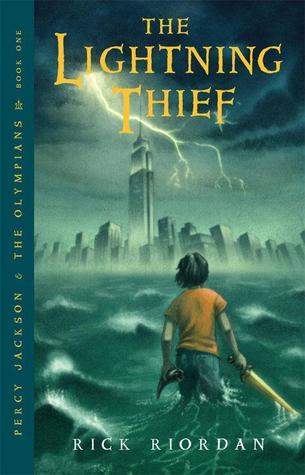
The Lightning Thief (Percy Jackson and the Olympians #1) by Rick Riordan Review


The Lightning Thief (Percy Jackson and the Olympians, #1)

Fiction
377 pages

Percy Jackson is a good kid, but he can't seem to focus on his schoolwork or control his temper. And lately, being away at boarding school is only getting worse-Percy could have sworn his pre-algebra teacher turned into a monster and tried to kill him. When Percy's mom finds out, she knows it's time that he knew the truth about where he came from, and that he go to the one place he'll be safe. She sends Percy to Camp Half Blood, a summer camp for demigods (on Long Island), where he learns that the father he never knew is Poseidon, God of the Sea. Soon a mystery unfolds and together with his friends -- one a satyr and the other the demigod daughter of Athena -- Percy sets out on a quest across the United States to reach the gates of the Underworld (located in a recording studio in Hollywood) and prevent a catastrophic war between the gods.

Completion: A+
Writing/Style: A
Characters: A
Plot/Pacing: A
World-building/Atmosphere: A+
Subgenres (Romance, Humor, Mystery, etc.): A+

Final Grade: A Get Thee to a Bookstore!

Who knew I would like a middle grade book?
As a 21 year old, I thought I was way past middle grade books, but I was very, very, very wrong. Now that might sound a little pretentious to underestimate middle grade books like that, but as a kid I was very precocious AND pretentious. I practically skipped elementary and middle grade books all together. My reading level was so high that I prided myself on reading the hardest books in my school and public libraries. However, I am so glad for the continued fame of Percy Jackson and for my cousin who persuaded me to read this series.
I can now see why Percy Jackson is compared to Harry Potter: it is contagiously fun. Riordan takes the basic hero’s journey and makes it fresh again. I also appreciated that how the characters, main and side characters, were balanced: talented but believable. As well, the book tackles disabilities which is all too often overlooked or omitted.
As far as the story goes, you can go into this book not knowing anything about Greek mythology, but it’s extra fun if you do. I was so excited to see what sort of twists Riordan was going to pull on these classics, and he didn’t disappoint. Riordan’s imaginings of Greek gods and legends are witty, humorous, and yet just serious enough for me to invest in them. Reading this book, I could tell how much fun he must have had putting all of this together.
After I finished, I immediately went out and got the next in the series. Probably the best thing about this series is the humor. It is so on point that it appeals to this 21 year old as much as it would have appealed to my 10 year old self. This was a light quick read that I would definitely recommend but especially for the summer.

Mild Spoiler of the Ending: 
This didn’t change my overall opinion of the book, but it did worry me a little bit. The reader quickly discovers that Percy’s mother is dating an abusive man in order to protect Percy. At the end of the novel, Percy is determined to kill/turn-to-stone this man with Medusa’s head, but his mother convinces him otherwise. Percy leaves her the head, and it is implied that Percy’s mother later uses the Medusa head on this man. Now, while this might have only been intended as humor or a convenient way of getting rid of the man, it worries me that “revenge” or violence on an abuser would be portrayed in this series. Now, I am not one who believes that children cannot handle hard topics or issues. And yet, the tone of the novel is confused in this scene as the mother is able to so casually and callously dispose of this man she was with and without any consequences or repercussions. It leaves a rather light-hearted story on a dark and unnecessary note.